
The Evolution of Global International Reserves
When we talk about financial security at a global scale, international reserves play the same role as an emergency fund does for households. Countries keep reserves to safeguard against external shocks, stabilize their currency, and ensure smooth trade. But what’s more interesting is how the composition of these reserves has changed over time and continues to change.
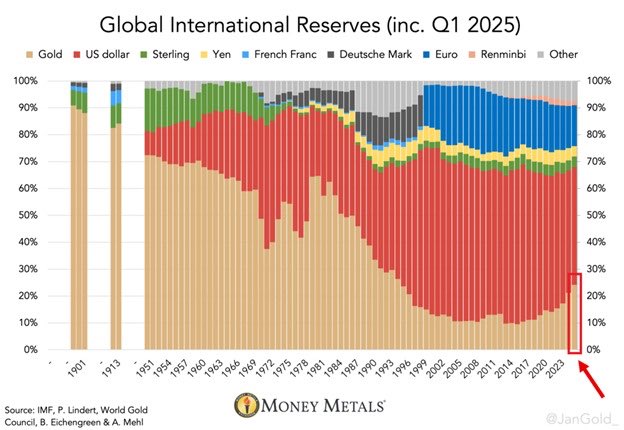
The data from the IMF shows a fascinating journey:
- 1965 – Gold was still the king. About 70% of global reserves were held in gold, with currencies making up just 30%.
- 1980 – The US dollar had risen strongly. Gold dropped to 40%, while the dollar and other currencies started dominating.
- 1995 – A sharp shift happened. Gold was down to 10%, and the US dollar made up almost 70% of global reserves.
- 2020 – The world was no longer dollar-only. The dollar fell below 60%, the euro rose to 20%, and other currencies like the yen, pound, and the Chinese renminbi also gained space. Gold revived to about 15%.
- 2023–2024 latest data – The US dollar remains the largest reserve currency, but its share is gradually declining, while gold and “other currencies” (non-dollar, non-euro) are inching higher.
What Does This Tell Us?
- No asset remains dominant forever
Gold was once everything, then it was ignored, and now it’s making a comeback. The US dollar looked untouchable, but diversification is happening at a global level. - Global diversification is a signal for individual investors
If countries don’t put all their eggs in one basket, why should you? Just like the world shifts between gold, USD, and other currencies, you should balance equity, debt, and gold in your portfolio. - Geopolitics shapes money flows
Sanctions, trade wars, inflation, and interest rate policies push central banks to rebalance reserves. Similarly, your personal financial plan must adjust with inflation, interest rate cycles, and market valuations. - Gold is not outdated
Central banks have been steadily buying gold again. For individual investors, a small allocation (5–10%) in gold ETFs or sovereign gold bonds can act as a hedge against global uncertainty.
Lessons for Indian Investors
- Don’t rely on only one asset class – Just like the dollar is losing some share, equities too will have ups and downs. Debt funds, gold, and international diversification can stabilize long-term wealth.
- Think long-term – These changes in reserves happen over decades, not months. Similarly, wealth building through SIPs and compounding is a marathon, not a sprint.
- Adapt to change – What worked 30 years ago may not work today. Review your portfolio regularly and make adjustments when needed.
Final Thought
The global reserve chart is more than just numbers—it’s a mirror of human financial behavior. Over-reliance on one thing always leads to risk, and eventually, balance is restored. For you as an investor, the lesson is clear: stay diversified, stay disciplined, and stay adaptable.
Data Source: IMF COFER (Currency Composition of Official Foreign Exchange Reserves), 1965–2023
Disclaimer: This blog is for educational purposes only. Investors should consult financial experts before making decisions.

Hi, I’m Managing Director at Gurpreet Saluja Financial Services Pvt. Ltd. Where I help my investors to invest in mutual funds and achieve their financial goals. I’m also a Value Investor and here I write about Personal Finance & Investing.